Modern steganography entered the world in 1985 with the advent of the Personal Computer applied to classical steganography problems. Development following that was slow, but has since taken off, based upon the number of 'stego' programs available.
* Concealing messages within the lowest bits of noisy images or sound files.
* Concealing data within encrypted data. The data to be concealed is first encrypted before being used to overwrite part of a much larger block of encrypted data.
* Chaffing and winnowing
* Mimic functions convert one file to have the statistical profile of another.
This can thwart statistical methods that help brute-force attacks identify the right solution in a ciphertext-only attack.
* Invisible ink
* Null ciphers
* Concealed messages in tampered executable files, exploiting redundancy in the i386 instruction set
* Embedded pictures in video material (optionally played at slower or faster speed).
* A new steganographic technique involves injecting imperceptible delays to packets sent over the network from the keyboard. Delays in keypresses in some applications (telnet or remote desktop software) can mean a delay in packets, and the delays in the packets can be used to encode data.
* Content-Aware Steganography hides information in the semantics a human user assigns to a datagram; these systems offer security against a non-human adversary/warden.
* BPCS-Steganography - a very large embedding capacity steganography.
* Blog-Steganography. Messages are fractionalyzed and the (encrypted) pieces are added as comments of orphaned web-logs (or pin boards on social network platforms). In this case the selection of blogs is the symmetric key that sender and recipient are using. The carrier of the hidden message is the whole blogosphere.
Steganography is the art and science of writing hidden messages in such a way that no-one apart from the sender and intended recipient even realizes there is a hidden message. By contrast, cryptography obscures the meaning of a message, but it does not conceal the fact that there is a message. Today, the term steganography includes the concealment of digital information within computer files. For example, the sender might start with an ordinary-looking image file, then adjust the color of every 100th pixel to correspond to a letter in the alphabet—a change so subtle that someone who isn't actively looking for it is unlikely to notice it.
The word steganography is of Greek origin and means "covered, or hidden writing". Its ancient origins can be traced back to 440 BC. Herodotus mentions two examples of steganography in The Histories of Herodotus. Demaratus sent a warning about a forthcoming attack to Greece by writing it on a wooden panel and covering it in wax. Wax tablets were in common use then as re-usable writing surfaces, sometimes used for shorthand. Another ancient example is that of Histiaeus, who shaved the head of his most trusted slave and tattooed a message on it. After his hair had grown the message was hidden. The purpose was to instigate a revolt against the Persians. Later, Johannes Trithemius published the book Steganographia, a treatise on cryptography and steganography disguised as a grimoire.
Generally, a steganographic message will appear to be something else: a picture, an article, a shopping list, or some other message. This apparent message is the covertext. For instance, a message may be hidden by using invisible ink between the visible lines of innocuous documents.
The advantage of steganography over cryptography alone is that messages do not attract attention to themselves, to messengers, or to recipients. An unhidden coded message, no matter how unbreakable it is, will arouse suspicion and may in itself be incriminating, as in countries where encryption is illegal. Often, steganography and cryptography are used together to ensure security of the covert message.
Electronic communications can include steganographic coding inside of a transport layer, such as a file, or a protocol, such as UDP. Media files are ideal for steganographic transmission because of their large size, and are usually compressed either losslessly, as with FLAC or PNG, or lossily, as with JPEG images, MPEG video, or MP3 audio.
A steganographic message (the plaintext) is often first encrypted by some traditional means, producing a ciphertext. Then, a covertext is modified in some way to contain the ciphertext, resulting in stegotext. For example, the letter size, spacing, typeface, or other characteristics of a covertext can be manipulated to carry the hidden message; only the recipient (who must know the technique used) can recover the message and then decrypt it. Francis Bacon developed Bacon's cipher as such a technique.
by:wikipedia
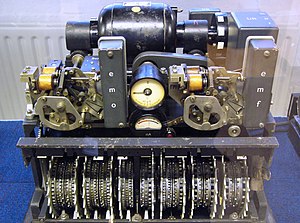
CryptographyThe German Lorenz cipher machine, used in World War II for encryption of very high-level general staff messages
Cryptography (or cryptology; from Greek κρυπτός, kryptos, "hidden, secret"; and γράφω, gráphō, "I write", or -λογία, -logia, respectively)[1] is the practice and study of hiding information. In modern times, cryptography is considered a branch of both mathematics and computer science, and is affiliated closely with information theory, computer security, and engineering. Cryptography is used in applications present in technologically advanced societies; examples include the security of ATM cards, computer passwords, and electronic commerce, which all depend on cryptography.
Terminology
Until modern times, cryptography referred almost exclusively to encryption, the process of converting ordinary information (plaintext) into unintelligible gibberish (i.e., ciphertext). Decryption is the reverse, moving from unintelligible ciphertext to plaintext. A cipher (or cypher) is a pair of algorithms which creates the encryption and the reversing decryption. The detailed operation of a cipher is controlled both by the algorithm and, in each instance, by a key. This is a secret parameter (ideally, known only to the communicants) for a specific message exchange context. Keys are important, as ciphers without variable keys are trivially breakable and therefore less than useful for most purposes. Historically, ciphers were often used directly for encryption or decryption, without additional procedures such as authentication or integrity checks.
In colloquial use, the term "code" is often used to mean any method of encryption or concealment of meaning. However, in cryptography, code has a more specific meaning; it means the replacement of a unit of plaintext (i.e., a meaningful word or phrase) with a code word (for example, apple pie replaces attack at dawn). Codes are no longer used in serious cryptography—except incidentally for such things as unit designations (e.g., Bronco Flight or Operation Overlord) —- since properly chosen ciphers are both more practical and more secure than even the best codes, and better adapted to computers as well.
Some use the terms cryptography and cryptology interchangeably in English, while others use cryptography to refer specifically to the use and practice of cryptographic techniques, and cryptology to refer to the combined study of cryptography and cryptanalysis.
The study of characteristics of languages which have some application in cryptology, i.e. frequency data, letter combinations, universal patterns, etc. is called Cryptolinguistics.
The Ancient Greek scytale (rhymes with Italy), probably much like this modern reconstruction, may have been one of the earliest devices used to implement a cipher.
Before the modern era, cryptography was concerned solely with message confidentiality (i.e., encryption) — conversion of messages from a comprehensible form into an incomprehensible one, and back again at the other end, rendering it unreadable by interceptors or eavesdroppers without secret knowledge (namely, the key needed for decryption of that message). In recent decades, the field has expanded beyond confidentiality concerns to include techniques for message integrity checking, sender/receiver identity authentication, digital signatures, interactive proofs, and secure computation, amongst others.
The earliest forms of secret writing required little more than local pen and paper analogs, as most people could not read. More literacy, or opponent literacy, required actual cryptography. The main classical cipher types are transposition ciphers, which rearrange the order of letters in a message (e.g., 'help me' becomes 'ehpl em' in a trivially simple rearrangement scheme), and substitution ciphers, which systematically replace letters or groups of letters with other letters or groups of letters (e.g., 'fly at once' becomes 'gmz bu podf' by replacing each letter with the one following it in the English alphabet). Simple versions of either offered little confidentiality from enterprising opponents, and still don't. An early substitution cipher was the Caesar cipher, in which each letter in the plaintext was replaced by a letter some fixed number of positions further down the alphabet. It was named after Julius Caesar who is reported to have used it, with a shift of 3, to communicate with his generals during his military campaigns, just like EXCESS-3 code in boolean algebra.
Encryption attempts to ensure secrecy in communications, such as those of spies, military leaders, and diplomats. There is record of several early Hebrew ciphers as well. Cryptography is recommended in the Kama Sutra as a way for lovers to communicate without inconvenient discovery. Steganography (i.e., hiding even the existence of a message so as to keep it confidential) was also first developed in ancient times. An early example, from Herodotus, concealed a message - a tattoo on a slave's shaved head - under the regrown hair. More modern examples of steganography include the use of invisible ink, microdots, and digital watermarks to conceal information.
Ciphertexts produced by classical ciphers (and some modern ones) always reveal statistical information about the plaintext, which can often be used to break them. After the discovery of frequency analysis by the Arab mathematician and polymath, Al-Kindi (also known as Alkindus), in the 9th century, nearly all such ciphers became more or less readily breakable by an informed attacker. Such classical ciphers still enjoy popularity today, though mostly as puzzles (see cryptogram). Essentially all ciphers remained vulnerable to cryptanalysis using this technique until the development of the polyalphabetic cipher, most clearly by Leon Battista Alberti around the year 1467, though there is some indication that it was known to earlier Arab mathematicians such as Al-Kindi. Alberti's innovation was to use different ciphers (i.e., substitution alphabets) for various parts of a message (perhaps for each successive plaintext letter in the limit). He also invented what was probably the first automatic cipher device, a wheel which implemented a partial realization of his invention. In the polyalphabetic Vigenère cipher, encryption uses a key word, which controls letter substitution depending on which letter of the key word is used. In the mid 1800s Babbage showed that polyalphabetic ciphers of this type remained partially vulnerable to frequency analysis techniques.
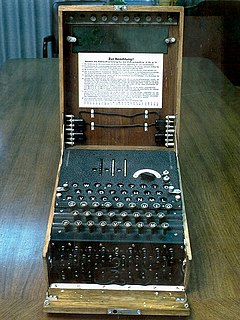
The Enigma machine, used in several variants by the German military between the late 1920s and the end of World War II, implemented a complex electro-mechanical polyalphabetic cipher to protect sensitive communications. Breaking the Enigma cipher at the Biuro Szyfrów, and the subsequent large-scale decryption of Enigma traffic at Bletchley Park, was an important factor contributing to the Allied victory in WWII.
Although frequency analysis is a powerful and general technique, encryption was still often effective in practice; many a would-be cryptanalyst was unaware of the technique. Breaking a message without frequency analysis essentially required knowledge of the cipher used, thus encouraging espionage, bribery, burglary, defection, etc. to discover it. It was finally explicitly recognized in the 19th century that secrecy of a cipher's algorithm is not a sensible or practical safeguard; in fact, it was further realized any adequate cryptographic scheme (including ciphers) should remain secure even if the adversary fully understands the cipher algorithm itself. Secrecy of the key should alone be sufficient for a good cipher to maintain confidentiality under attack. This fundamental principle was first explicitly stated in 1883 by Auguste Kerckhoffs and is generally called Kerckhoffs' principle; alternatively and more bluntly, it was restated by Claude Shannon as Shannon's Maxim — 'the enemy knows the system'.
Various physical devices and aids have been used to assist with ciphers. One of the earliest may have been the scytale of ancient Greece, a rod supposedly used by the Spartans as an aid for a transposition cipher. In medieval times, other aids were invented such as the cipher grille, also used for a kind of steganography. With the invention of polyalphabetic ciphers came more sophisticated aids such as Alberti's own cipher disk, Johannes Trithemius' tabula recta scheme, and Thomas Jefferson's multi-cylinder (reinvented independently by Bazeries around 1900). Several mechanical encryption/decryption devices were invented early in the 20th century, and many patented, among them rotor machines — most famously the Enigma machine used by Germany from the late 20s and in World War II. The ciphers implemented by better quality examples of these designs brought about a substantial increase in cryptanalytic difficulty after WWI.
The development of digital computers and electronics after WWII made possible much more complex ciphers. Furthermore, computers allowed for the encryption of any kind of data represented by computers in any binary format, unlike classical ciphers which only encrypted written language texts, thus dissolving much of the utility of a linguistic approach to cryptanalysis. Many computer ciphers can be characterized by their operation on binary bit sequences (sometimes in groups or blocks), unlike classical and mechanical schemes, which generally manipulate traditional characters (i.e., letters and digits) directly. However, computers have also assisted cryptanalysis, which has compensated to some extent for increased cipher complexity. Nonetheless, good modern ciphers have stayed ahead of cryptanalysis; it is typically the case that use of a quality cipher is very efficient (i.e., fast and requiring few resources), while breaking it requires an effort many orders of magnitude larger than before, making cryptanalysis so inefficient and impractical as to be effectively impossible.
A credit card with smart card capabilities. The 3 by 5 mm chip embedded in the card is shown enlarged in the insert. Smart cards attempt to combine portability with the power to compute modern cryptographic algorithms.
Extensive open academic research into cryptography is relatively recent — it began only in the mid-1970s with the public specification of DES (the Data Encryption Standard) by the US Government's National Bureau of Standards, the Diffie-Hellman paper,and the public release of the RSA algorithm. Since then, cryptography has become a widely used tool in communications, computer networks, and computer security generally. The present security level of many modern cryptographic techniques is based on the difficulty of certain computational problems, such as the integer factorisation or the discrete logarithm problems. In many cases, there are proofs that cryptographic techniques are secure if a certain computational problem cannot be solved efficiently. With one notable exception -— the one-time pad —- these proofs are contingent, and thus not definitive, but are currently the best available for cryptographic algorithms and protocols.
As well as being aware of cryptographic history, cryptographic algorithm and system designers must also sensibly consider probable future developments in their designs. For instance, continuous improvements in computer processing power have increased the scope of brute-force attacks, thus when specifying key lengths, the standard is similarly advancing. The potential effects of quantum computing are already being considered by some cryptographic system designers; the announced imminence of small implementations of these machines is making the need for this preemptive caution fully explicit.
Essentially, prior to the early 20th century, cryptography was chiefly concerned with linguistic patterns. Since then the emphasis has shifted, and cryptography now makes extensive use of mathematics, including aspects of information theory, computational complexity, statistics, combinatorics, abstract algebra, and number theory. Cryptography is also a branch of engineering, but an unusual one as it deals with active, intelligent, and malevolent opposition (see cryptographic engineering and security engineering); most other kinds of engineering need deal only with neutral natural forces. There is also active research examining the relationship between cryptographic problems and quantum physics (see quantum cryptography and quantum computing).
The modern field of cryptography can be divided into several areas of study. The chief ones are discussed here; see Topics in Cryptography for more.
Symmetric-key cryptography
Symmetric-key cryptography refers to encryption methods in which both the sender and receiver share the same key (or, less commonly, in which their keys are different, but related in an easily computable way). This was the only kind of encryption publicly known until June 1976.
One round (out of 8.5) of the patented IDEA cipher, used in some versions of PGP for high-speed encryption of, for instance, e-mail
The modern study of symmetric-key ciphers relates mainly to the study of block ciphers and stream ciphers and to their applications. A block cipher is, in a sense, a modern embodiment of Alberti's polyalphabetic cipher: block ciphers take as input a block of plaintext and a key, and output a block of ciphertext of the same size. Since messages are almost always longer than a single block, some method of knitting together successive blocks is required. Several have been developed, some with better security in one aspect or another than others. They are the mode of operations and must be carefully considered when using a block cipher in a cryptosystem.
The Data Encryption Standard (DES) and the Advanced Encryption Standard (AES) are block cipher designs which have been designated cryptography standards by the US government (though DES's designation was finally withdrawn after the AES was adopted). Despite its deprecation as an official standard, DES (especially its still-approved and much more secure triple-DES variant) remains quite popular; it is used across a wide range of applications, from ATM encryption to e-mail privacy and secure remote access. Many other block ciphers have been designed and released, with considerable variation in quality. Many have been thoroughly broken. See Category:Block ciphers.
Stream ciphers, in contrast to the 'block' type, create an arbitrarily long stream of key material, which is combined with the plaintext bit-by-bit or character-by-character, somewhat like the one-time pad. In a stream cipher, the output stream is created based on an internal state which changes as the cipher operates. That state change is controlled by the key, and, in some stream ciphers, by the plaintext stream as well. RC4 is an example of a well-known, and widely used, stream cipher; see Category:Stream ciphers.
Cryptographic hash functions (often called message digest functions) do not necessarily use keys, but are a related and important class of cryptographic algorithms. They take input data (often an entire message), and output a short, fixed length hash, and do so as a one-way function. For good ones, collisions (two plaintexts which produce the same hash) are extremely difficult to find.
Message authentication codes (MACs) are much like cryptographic hash functions, except that a secret key is used to authenticate the hash value[10] on receipt. These block an attack against plain hash functions.
Public-key cryptography
Symmetric-key cryptosystems use the same key for encryption and decryption of a message, though a message or group of messages may have a different key than others. A significant disadvantage of symmetric ciphers is the key management necessary to use them securely. Each distinct pair of communicating parties must, ideally, share a different key, and perhaps each ciphertext exchanged as well. The number of keys required increases as the square of the number of network members, which very quickly requires complex key management schemes to keep them all straight and secret. The difficulty of securely establishing a secret key between two communicating parties, when a secure channel doesn't already exist between them, also presents a chicken-and-egg problem which is a considerable practical obstacle for cryptography users in the real world.
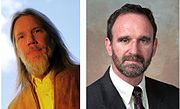
Whitfield Diffie and Martin Hellman, authors of the first paper on public-key cryptography
In addition to encryption, public-key cryptography can be used to implement digital signature schemes. A digital signature is reminiscent of an ordinary signature; they both have the characteristic that they are easy for a user to produce, but difficult for anyone else to forge. Digital signatures can also be permanently tied to the content of the message being signed; they cannot then be 'moved' from one document to another, for any attempt will be detectable. In digital signature schemes, there are two algorithms: one for signing, in which a secret key is used to process the message (or a hash of the message, or both), and one for verification, in which the matching public key is used with the message to check the validity of the signature. RSA and DSA are two of the most popular digital signature schemes. Digital signatures are central to the operation of public key infrastructures and many network security schemes (eg, SSL/TLS, many VPNs, etc).
In a groundbreaking 1976 paper, Whitfield Diffie and Martin Hellman proposed the notion of public-key (also, more generally, called asymmetric key) cryptography in which two different but mathematically related keys are used — a public key and a private key.[16] A public key system is so constructed that calculation of one key (the 'private key') is computationally infeasible from the other (the 'public key'), even though they are necessarily related. Instead, both keys are generated secretly, as an interrelated pair. The historian David Kahn described public-key cryptography as "the most revolutionary new concept in the field since polyalphabetic substitution emerged in the Renaissance".
In public-key cryptosystems, the public key may be freely distributed, while its paired private key must remain secret. The public key is typically used for encryption, while the private or secret key is used for decryption. Diffie and Hellman showed that public-key cryptography was possible by presenting the Diffie-Hellman key exchange protocol.
In 1978, Ronald Rivest, Adi Shamir, and Len Adleman invented RSA, another public-key system.
In 1997, it finally became publicly known that asymmetric key cryptography had been invented by James H. Ellis at GCHQ, a British intelligence organization, and that, in the early 1970s, both the Diffie-Hellman and RSA algorithms had been previously developed (by Malcolm J. Williamson and Clifford Cocks, respectively).
The Diffie-Hellman and RSA algorithms, in addition to being the first publicly known examples of high quality public-key algorithms, have been among the most widely used. Others include the Cramer-Shoup cryptosystem, ElGamal encryption, and various elliptic curve techniques. See Category:Asymmetric-key cryptosystems.
Public-key algorithms are most often based on the computational complexity of "hard" problems, often from number theory. For example, the hardness of RSA is related to the integer factorization problem, while Diffie-Hellman and DSA are related to the discrete logarithm problem. More recently, elliptic curve cryptography has developed in which security is based on number theoretic problems involving elliptic curves. Because of the difficulty of the underlying problems, most public-key algorithms involve operations such as modular multiplication and exponentiation, which are much more computationally expensive than the techniques used in most block ciphers, especially with typical key sizes. As a result, public-key cryptosystems are commonly hybrid cryptosystems, in which a fast high-quality symmetric-key encryption algorithm is used for the message itself, while the relevant symmetric key is sent with the message, but encrypted using a public-key algorithm. Similarly, hybrid signature schemes are often used, in which a cryptographic hash function is computed, and only the resulting hash is digitally signed.
Cryptanalysis
Monument to Polish cryptologists who supported Allied victory, Poznan
The goal of cryptanalysis is to find some weakness or insecurity in a cryptographic scheme, thus permitting its subversion or evasion.
It is a commonly held misconception that every encryption method can be broken. In connection with his WWII work at Bell Labs, Claude Shannon proved that the one-time pad cipher is unbreakable, provided the key material is truly random, never reused, kept secret from all possible attackers, and of equal or greater length than the message. Most ciphers, apart from the one-time pad, can be broken with enough computational effort by brute force attack, but the amount of effort needed may be exponentially dependent on the key size, as compared to the effort needed to use the cipher. In such cases, effective security could be achieved if it is proven that the effort required (i.e., "work factor", in Shannon's terms) is beyond the ability of any adversary. This means it must be shown that no efficient method (as opposed to the time-consuming brute force method) can be found to break the cipher. Since no such showing can be made currently, as of today, the one-time-pad remains the only theoretically unbreakable cipher.
There are a wide variety of cryptanalytic attacks, and they can be classified in any of several ways. A common distinction turns on what an attacker knows and what capabilities are available. In a ciphertext-only attack, the cryptanalyst has access only to the ciphertext (good modern cryptosystems are usually effectively immune to ciphertext-only attacks). In a known-plaintext attack, the cryptanalyst has access to a ciphertext and its corresponding plaintext (or to many such pairs). In a chosen-plaintext attack, the cryptanalyst may choose a plaintext and learn its corresponding ciphertext (perhaps many times); an example is gardening, used by the British during WWII. Finally, in a chosen-ciphertext attack, the cryptanalyst may be able to choose ciphertexts and learn their corresponding plaintexts. Also important, often overwhelmingly so, are mistakes (generally in the design or use of one of the protocols involved; see Cryptanalysis of the Enigma for some historical examples of this).
Cryptanalysis of symmetric-key ciphers typically involves looking for attacks against the block ciphers or stream ciphers that are more efficient than any attack that could be against a perfect cipher. For example, a simple brute force attack against DES requires one known plaintext and 255 decryptions, trying approximately half of the possible keys, to reach a point at which chances are better than even the key sought will have been found. But this may not be enough assurance; a linear cryptanalysis attack against DES requires 243 known plaintexts and approximately 243 DES operations. This is a considerable improvement on brute force attacks.
Public-key algorithms are based on the computational difficulty of various problems. The most famous of these is integer factorization (e.g., the RSA algorithm is based on a problem related to integer factoring), but the discrete logarithm problem is also important. Much public-key cryptanalysis concerns numerical algorithms for solving these computational problems, or some of them, efficiently (ie, in a practical time). For instance, the best known algorithms for solving the elliptic curve-based version of discrete logarithm are much more time-consuming than the best known algorithms for factoring, at least for problems of more or less equivalent size. Thus, other things being equal, to achieve an equivalent strength of attack resistance, factoring-based encryption techniques must use larger keys than elliptic curve techniques. For this reason, public-key cryptosystems based on elliptic curves have become popular since their invention in the mid-1990s.
While pure cryptanalysis uses weaknesses in the algorithms themselves, other attacks on cryptosystems are based on actual use of the algorithms in real devices, and are called side-channel attacks. If a cryptanalyst has access to, say, the amount of time the device took to encrypt a number of plaintexts or report an error in a password or PIN character, he may be able to use a timing attack to break a cipher that is otherwise resistant to analysis. An attacker might also study the pattern and length of messages to derive valuable information; this is known as traffic analysis, and can be quite useful to an alert adversary. Poor administration of a cryptosystem, such as permitting too short keys, will make any system vulnerable, regardless of other virtues. And, of course, social engineering, and other attacks against the personnel who work with cryptosystems or the messages they handle (e.g., bribery, extortion, blackmail, espionage, torture, ...) may be the most productive attacks of all.
Cryptographic primitives
Much of the theoretical work in cryptography concerns cryptographic primitives — algorithms with basic cryptographic properties — and their relationship to other cryptographic problems. More complicated cryptographic tools are then built from these basic primitives. Complex functionality in an application must be built in using combinations of these algorithms and assorted protocols. Such combinations are called cryptosystems and it is they which users actually encounter. Examples include PGP and its variants, ssh, SSL/TLS, all PKIs, digital signatures, etc. For example, a one-way function is a function intended to be easy to compute but hard to invert.
But note that, in a very general sense, for any cryptographic application to be secure (if based on computational feasibility assumptions), one-way functions must exist. However, if one-way functions exist, this implies that P ≠ NP. Since the P versus NP problem is currently unsolved, it is not known if one-way functions really do exist. For instance, if one-way functions exist, then secure pseudorandom generators and secure pseudorandom functions exist.
Other cryptographic primitives include the encryption algorithms themselves, one-way permutations, trapdoor permutations, etc.
Cryptographic protocols
In many cases, cryptographic techniques involve back and forth communication among two or more parties in space (e.g., between the home office and a branch office) or across time (e.g., cryptographically protected backup data). The term cryptographic protocol captures this general idea.
Cryptographic protocols have been developed for a wide range of problems, including relatively simple ones like interactive proof systems, secret sharing, and zero-knowledge proofs,[28] and much more complex ones like electronic cash and secure multiparty computation.
When the security of a good cryptographic system fails, it is rare that the vulnerability leading to the breach will have been in a quality cryptographic primitive. Instead, weaknesses are often mistakes in the protocol design (often due to inadequate design procedures, or less than thoroughly informed designers), in the implementation (e.g., a software bug), in a failure of the assumptions on which the design was based (e.g., proper training of those who will be using the system), or some other human error.
Many cryptographic protocols have been designed and analyzed using ad hoc methods, but they rarely have any proof of security, leaving aside the effects of humans in their operations. Methods for formally analyzing the security of protocols, based on techniques from mathematical logic (see for example BAN logic), and more recently from concrete security principles, have been the subject of research for the past few decades. Unfortunately, to date these tools have been cumbersome and are not widely used for complex designs.
The study of how best to implement and integrate cryptography in applications is itself a distinct field, see: cryptographic engineering and security engineering.
Prohibitions
Cryptography has long been of interest to intelligence gathering and law enforcement agencies. Actually secret communications may be criminal or even treasonous; those whose communications are open to inspection may be less likely to be either. Because of its facilitation of privacy, and the diminution of privacy attendant on its prohibition, cryptography is also of considerable interest to civil rights supporters. Accordingly, there has been a history of controversial legal issues surrounding cryptography, especially since the advent of inexpensive computers has made possible widespread access to high quality cryptography.
In some countries, even the domestic use of cryptography is, or has been, restricted. Until 1999, France significantly restricted the use of cryptography domestically. In China, a license is still required to use cryptography. Many countries have tight restrictions on the use of cryptography. Among the more restrictive are laws in Belarus, Kazakhstan, Mongolia, Pakistan, Russia, Singapore, Tunisia, Venezuela, and Vietnam.
In the United States, cryptography is legal for domestic use, but there has been much conflict over legal issues related to cryptography. One particularly important issue has been the export of cryptography and cryptographic software and hardware. Because of the importance of cryptanalysis in World War II and an expectation that cryptography would continue to be important for national security, many western governments have, at some point, strictly regulated export of cryptography. After World War II, it was illegal in the US to sell or distribute encryption technology overseas; in fact, encryption was defined legally to be a munition.
Until the advent of the personal computer and the Internet, this was not especially problematic. Good cryptography is indistinguishable from bad cryptography for nearly all users, and in any case, most of the cryptographic techniques generally available were slow and error prone whether good or bad. However, as the Internet grew and computers became more widely available, high quality encryption techniques became well-known around the globe. As a result, export controls came to be seen to be an impediment to commerce and to research.
Export Controls
In the 1990s, there were several challenges to US export regulations of cryptography. One involved Philip Zimmermann's Pretty Good Privacy (PGP) encryption program; it was released in the US, together with its source code, and found its way onto the Internet in June 1991. After a complaint by RSA Security (then called RSA Data Security, Inc., or RSADSI), Zimmermann was criminally investigated by the Customs Service and the FBI for several years. No charges were ever filed, however. Also, Daniel Bernstein, then a graduate student at UC Berkeley, brought a lawsuit against the US government challenging some aspects of the restrictions based on free speech grounds. The 1995 case Bernstein v. United States which ultimately resulted in a 1999 decision that printed source code for cryptographic algorithms and systems was protected as free speech by the United States Constitution.
In 1996, thirty-nine countries signed the Wassenaar Arrangement, an arms control treaty that deals with the export of arms and "dual-use" technologies such as cryptography. The treaty stipulated that the use of cryptography with short key-lengths (56-bit for symmetric encryption, 512-bit for RSA) would no longer be export-controlled. Cryptography exports from the US are now much less strictly regulated than in the past as a consequence of a major relaxation in 2000; there are no longer very many restrictions on key sizes in US-exported mass-market software. In practice today, since the relaxation in US export restrictions, and because almost every personal computer connected to the Internet, everywhere in the world, includes US-sourced web browsers such as Mozilla Firefox or Microsoft Internet Explorer, almost every Internet user worldwide has access to quality cryptography (i.e., when using sufficiently long keys with properly operating and unsubverted software, etc) in their browsers; examples are Transport Layer Security or SSL stack. The Mozilla Thunderbird and Microsoft Outlook E-mail client programs similarly can connect to IMAP or POP servers via TLS, and can send and receive email encrypted with S/MIME. Many Internet users don't realize that their basic application software contains such extensive cryptosystems. These browsers and email programs are so ubiquitous that even governments whose intent is to regulate civilian use of cryptography generally don't find it practical to do much to control distribution or use of cryptography of this quality, so even when such laws are in force, actual enforcement is often effectively impossible.
NSA involvement
Another contentious issue connected to cryptography in the United States is the influence of the National Security Agency on cipher development and policy. NSA was involved with the design of DES during its development at IBM and its consideration by the National Bureau of Standards as a possible Federal Standard for cryptography. DES was designed to be resistant to differential cryptanalysis, a powerful and general cryptanalytic technique known to NSA and IBM, that became publicly known only when it was rediscovered in the late 1980s. According to Steven Levy, IBM rediscovered differential cryptanalysis, but kept the technique secret at NSA's request. The technique became publicly known only when Biham and Shamir re-rediscovered and announced it some years later. The entire affair illustrates the difficulty of determining what resources and knowledge an attacker might actually have.
Another instance of NSA's involvement was the 1993 Clipper chip affair, an encryption microchip intended to be part of the Capstone cryptography-control initiative. Clipper was widely criticized by cryptographers for two reasons. The cipher algorithm was then classified (the cipher, called Skipjack, though it was declassified in 1998 long after the Clipper initiative lapsed). The secret cipher caused concerns that NSA had deliberately made the cipher weak in order to assist its intelligence efforts. The whole initiative was also criticized based on its violation of Kerckhoffs' principle, as the scheme included a special escrow key held by the government for use by law enforcement, for example in wiretaps.
Digital Rights Management
Cryptography is central to digital rights management (DRM), a group of techniques for technologically controlling use of copyrighted material, being widely implemented and deployed at the behest of some copyright holders. In 1998, American President Bill Clinton signed the Digital Millennium Copyright Act (DMCA), which criminalized all production, dissemination, and use of certain cryptanalytic techniques and technology (now known or later discovered); specifically, those that could be used to circumvent DRM technological schemes. This had a noticeable impact on the cryptography research community since an argument can be made that any cryptanalytic research violated, or might violate, the DMCA. Similar statutes have since been enacted in several countries and regions, including the implementation in the EU Copyright Directive. Similar restrictions are called for by treaties signed by World Intellectual Property Organization member-states.
The United States Department of Justice and FBI have not enforced the DMCA as rigorously as had been feared by some, but the law, nonetheless, remains a controversial one. One well-respected cryptography researcher, Niels Ferguson, has publicly stated that he will not release some of his research into an Intel security design for fear of prosecution under the DMCA, and both Alan Cox (longtime number 2 in Linux kernel development) and Professor Edward Felten (and some of his students at Princeton) have encountered problems related to the Act. Dmitry Sklyarov was arrested during a visit to the US from Russia, and jailed for some months for alleged violations of the DMCA which had occurred in Russia, where the work for which he was arrested and charged was then, and when he was arrested, legal. In 2007, the cryptographic keys responsible for DVD and HD DVD content scrambling were discovered and released onto the internet. Both times, the MPAA sent out numerous DMCA takedown notices, and there was a massive internet backlash as a result of the implications of such notices on fair use and free speech both legally protected in the US and in some other jurisdictions.
BitLocker Drive Encryption is a full disk encryption feature included with Microsoft's Windows Vista Ultimate, Windows Vista Enterprise and Windows Server 2008 operating systems designed to protect data by providing encryption for entire volumes. By default it uses the AES encryption algorithm in CBC mode with a 128 bit key, combined with the Elephant diffuser for additional disk encryption specific security not provided by AES.
BitLocker is only available in the Enterprise and Ultimate editions of Windows Vista. In the RTM release of Windows Vista, only the operating system volume could be encrypted using the GUI and encrypting other volumes required using WMI-based scripts included in Windows Vista in the %Windir\System32 folder. An example of how to use the WMI interface is in the script manage-bde.wsf, that can be used to set up and manage BitLocker from the command line. With Windows Vista Service Pack 1 and Windows Server 2008, volumes other than the operating system volume can be BitLocker-protected using the graphical Control Panel applet as well.
Overview
There are three implementation models for BitLocker encryption. Two models require a cryptographic hardware chip called a Trusted Platform Module (version 1.2 or later) and a compatible BIOS. A third model does not have the TPM chip requirement:
Transparent operation mode: This mode exploits the capabilities of the TPM 1.2 hardware to provide for a transparent user experience—the user logs onto Windows Vista as normal. The key used for the disk encryption is sealed (encrypted) by the TPM chip and will only be released to the OS loader code if the early boot files appear to be unmodified. The pre-OS components of BitLocker achieve this by implementing a Static Root of Trust Measurement—a methodology specified by the Trusted Computing Group. This mode is vulnerable to a cold boot attack, as it allows a machine to be booted by an attacker.
User authentication mode: This mode requires that the user provide some authentication to the pre-boot environment in order to be able to boot the OS. Two authentication modes are supported: a pre-boot PIN entered by the user, or a USB key.
The third model, without the TPM chip requirement:
USB Key Mode: The user must insert a USB device that contains a startup key into the computer to be able to boot the protected OS. Note that this mode requires that the BIOS on the protected machine supports the reading of USB devices in the pre-OS environment.
The following permutations of the above are supported, all with an optional escrow key[6] in Active Directory:
TPM only
TPM + PIN
TPM + PIN + USB Key
TPM + USB Key
USB Key
Operation
Contrary to the official name, BitLocker Drive Encryption is a logical volume encryption system. A volume may or may not be an entire drive, and can span one or more physical drives. Also, when enabled TPM/Bitlocker can ensure the integrity of the trusted boot path (e.g. BIOS, boot sector, etc.), in order to prevent most offline physical attacks, boot sector malware, etc.
In order for BitLocker to operate, the hard disk requires at least two NTFS-formatted volumes: one for the operating system (usually C:) and another with a minimum size of 1.5GB where the operating system boots from. BitLocker requires the boot volume to remain unencrypted, so it should not be used to store confidential information. Unlike previous versions of Windows, Vista's "diskpart" command-line tool includes the ability to shrink the size of an NTFS volume so that the system volume for BitLocker can be created. A tool called the "Bitlocker Drive Preparation Tool" is also available from Microsoft that allows an existing volume to be shrunk to make place for a new boot volume, and for the necessary bootstrapping files to be transferred to it.[12]
Once an alternate boot partition has been created, the TPM module needs to be initialized (assuming that this feature is being used), after which the required disk encryption key protection mechanisms such as TPM, PIN or USB key are configured. The volume is then encrypted as a background task, something that can take a considerable amount of time with a large disk. Only once the whole volume has been encrypted are the keys protected, and it considered secure.
Encrypting File System may be used in conjunction with BitLocker to provide protection once the operating system kernel has been loaded. Since BitLocker decrypts on-disk files before the Windows operating system has loaded (and thus outside of the operating system context), all file operations from the perspective of the operating system will proceed as if there is no encryption on the files being accessed by the operating system. Protection of the files from processes/users within the operating system can only be performed using encryption software that operates within Windows, such as Encrypting File System. BitLocker and Encrypting File System therefore offer protection against different classes of attacks.
In Active Directory environments, BitLocker supports optional key escrow to Active Directory, although a schema update may be required for this to work (i.e. if the Active Directory Directory Services are hosted on a Windows version previous to Windows Server 2008).
Other systems like BitLocker can have their recovery key/password entry process could be spoofed by another bootmanager or OS install. Once the spoofed software captured the secret, it could be used to decrypt the VMK, which would then allow access to decrypt or modify any information on the user's BitLocker-encrypted hard disk. By configuring a TPM to protect the trusted boot pathway, including the BIOS and boot sector, this threat can be removed.
Security concerns
According to Microsoft sources, BitLocker does not contain an intentionally built-in backdoor; there is no way for law enforcement to have a guaranteed passage to the data on the user's drives that is provided by Microsoft. The possible existence of a backdoor has been one of the main concerns among power-users since the announcement of built-in encryption in Vista. Although the AES encryption algorithm used in Bitlocker is in the public domain, its actual implementation in BitLocker, as well as other components of the software, are closed source. The code is available for scrutiny by selected Microsoft partners and enterprises, subject to a non-disclosure agreement, however the wider security community cannot independently verify that there is not a backdoor built into the product and has to take Microsoft's word in this regard.
The "Transparent operation mode" and "User authentication mode" of BitLocker use the TPM hardware to detect if there are unauthorized changes to the pre-boot environment, including the BIOS and MBR. If any unauthorized changes are detected, BitLocker requests a recovery key on a USB device, or a recovery password entered by hand. Either of these cryptographic secrets are used to decrypt the Volume Master Key (VMK) and allow the bootup process to continue.
Nevertheless, in February 2008, a group of security researchers published details of a straightforward cold boot attack that allows a Bitlocker-protected machine to be compromised by booting the machine off a USB device into another operating system, then dumping the contents of pre-boot memory.[17] The attack relies on the fact that DRAM retains information for up to several minutes (or even longer if cooled) after power has been removed. Use of a TPM module alone does not offer any protection, as the keys are held in memory while Windows is running, although two-factor authentication, i.e. using TPM together with a PIN, offers better protection for machines that are not powered on when physical access to them is obtained. Similar full disk encryption mechanisms of other vendors and other operating systems, including Linux and Mac OS X, are vulnerable to the same attack.[17] The authors recommend that computers be powered down when not in physical control of the owner (rather than be left in a "sleep" state) and that a password also be required to boot the machine.
BitLocker can also operate in a "USB Key"-only mode. The security risk in this case is that the key is left with the computer, or that a malicious program (either pre-boot or post-boot Windows malware) could read the startup key off of the USB Key and store it. It could be used later to decrypt and access the BitLocker-secured hard disk. This risk can be reduced by removing the USB Key from the USB port before Vista completely starts up. This should prevent post-boot malware from capturing the key, or the key being stolen together with the computer.
Lastly, all software-based encryption systems are vulnerable to various side channel attacks such as acoustic cryptanalysis and hardware keyloggers.
Pretty Good Privacy (PGP) is a computer program that provides cryptographic privacy and authentication. PGP is often used for signing, encrypting and decrypting e-mails to increase the security of e-mail communications. It was originally created by Philip Zimmermann in 1991.
PGP and other similar products follow the OpenPGP standard (RFC 4880) for encrypting and decrypting data.
How PGP encryption works
PGP encryption uses public-key cryptography and includes a system which binds the public keys to a user name and/or an e-mail address. The first version of this system was generally known as a web of trust to contrast with the X.509 system which uses a hierarchical approach based on certificate authority and which was added to PGP implementations later. Current versions of PGP encryption include both alternatives through an automated key management server.
Digital signatures
PGP supports message authentication and integrity checking. The latter is used to detect whether a message has been altered since it was completed (the message integrity property), and the former to determine whether it was actually sent by the person/entity claimed to be the sender (a digital signature). In PGP, these are used by default in conjunction with encryption, but can be applied to plaintext as well. The sender uses PGP to create a digital signature for the message with either the RSA or DSA signature algorithms. To do so, PGP computes a hash (also called a message digest) from the plaintext, and then creates the digital signature from that hash using the sender's private keys.
Web of trust
Both when encrypting messages and when verifying signatures, it is critical that the public key one uses to send messages to someone or some entity actually does 'belong' to the intended recipient. Simply downloading a public key from somewhere is not overwhelming assurance of that association; deliberate (or accidental) spoofing is possible. PGP has, from its first versions, always included provisions for distributing a user's public keys in an 'identity certificate' which is so constructed cryptographically that any tampering (or accidental garble) is readily detectable. But merely making a certificate which is impossible to modify without being detected effectively is also insufficient. It can prevent corruption only after the certificate has been created, not before. Users must also ensure by some means that the public key in a certificate actually does belong to the person/entity claiming it. From its first release, PGP products have included an internal certificate 'vetting scheme' to assist with this; a trust model which has been called a web of trust. A given public key (or more specifically, information binding a user name to a key) may be digitally signed by a third party user to attest to the association between someone (actually a user name) and the key. There are several levels of confidence which can be included in such signatures. Although many programs read and write this information, few (if any) include this level of certification when calculating whether to trust a key.
The web of trust protocol was first described by Zimmermann in 1992 in the manual for PGP version 2.0:
"As time goes on, you will accumulate keys from other people that you may want to designate as trusted introducers. Everyone else will each choose their own trusted introducers. And everyone will gradually accumulate and distribute with their key a collection of certifying signatures from other people, with the expectation that anyone receiving it will trust at least one or two of the signatures. This will cause the emergence of a decentralized fault-tolerant web of confidence for all public keys."
The web of trust mechanism has advantages over a centrally managed Public key infrastructure scheme such as that used by S/MIME but has not been universally used. Users have been willing to accept certificates and check their validity manually or to simply accept them. The underlying problem has found no satisfactory solution.
Certificates
In the (more recent) OpenPGP specification, trust signatures can be used to support creation of certificate authorities. A trust signature indicates both that the key belongs to its claimed owner and that the owner of the key is trustworthy to sign other keys at one level below their own. A level 0 signature is comparable to a web of trust signature since only the validity of the key is certified. A level 1 signature is similar to the trust one has in a certificate authority because a key signed to level 1 is able to issue an unlimited number of level 0 signatures. A level 2 signature is highly analogous to the trust assumption users must rely on whenever they use the default certificate authority list (like those included in web browsers); it allows the owner of the key to make other keys certificate authorities.
PGP versions have always included a way to cancel ('revoke') identity certificates. A lost or compromised private key will require this if communication security is to be retained by that user. This is, more or less, equivalent to the certificate revocation lists of centralized PKI schemes. Recent PGP versions have also supported certificate expiration dates.
The problem of correctly identifying a public key as belonging to a particular user is not unique to PGP. All public key / private key cryptosystems have the same problem, if in slightly different guise, and no fully satisfactory solution is known. PGP's original scheme, at least, leaves the decision whether or not to use its endorsement/vetting system to the user, while most other PKI schemes do not, requiring instead that every certificate attested to by a central certificate authority be accepted as correct.
Security quality
To the best of publicly available information, there is no known method which will allow a person or group to break PGP encryption by cryptographic or computational means. Indeed, in 1996, cryptographer Bruce Schneier characterized an early version as being "the closest you're likely to get to military-grade encryption."[1] Early versions of PGP have been found to have theoretical vulnerabilities and so current versions are recommended. In addition to protecting data in transit over a network, PGP encryption can also be used to protect data in long-term data storage such as disk files.
The cryptographic security of PGP encryption depends on the assumption that the algorithms used are unbreakable by direct cryptanalysis with current equipment and techniques. For instance, in the original version, the RSA algorithm was used to encrypt session keys; RSA's security depends upon the one-way function nature of mathematical integer factoring. Likewise, the secret key algorithm used in PGP version 2 was IDEA, which might, at some future time, be found to have a previously unsuspected cryptanalytic flaw. Specific instances of current PGP, or IDEA, insecurities — if they exist — are not publicly known. As current versions of PGP have added additional encryption algorithms, the degree of their cryptographic vulnerability varies with the algorithm used. In practice, each of the algorithms in current use is not publicly known to have cryptanalytic weaknesses.
Any agency wanting to read PGP messages would probably use easier means than standard cryptanalysis, e.g. rubber-hose cryptanalysis or black-bag cryptanalysis i.e. installing some form of trojan horse or keystroke logging software/hardware on the target computer to capture encrypted keyrings and their passwords. The FBI has already used this attack against PGP in its investigations. However, it is important to note that any such vulnerabilities apply not just to PGP, but to all encryption software.
In 2003, an incident involving seized Psion PDAs belonging to members of the Red Brigade indicated that neither the Italian police nor the FBI were able to decode PGP-encrypted files stored on them.
A more recent incident in December 2006 (see United States v. Boucher) involving US customs agents and a seized laptop PC which allegedly contained child pornography indicates that US Government agencies find it "nearly impossible" to access PGP-encrypted files. Additionally, a judge ruling on the same case in November 2007 has stated that forcing the suspect to reveal his PGP pass-phrase would violate his Fifth Amendment rights i.e. a suspect's constitutional right not to incriminate himself.
History
Early history
Phil Zimmermann created the first version of PGP encryption in 1991. The name, "Pretty Good Privacy", is humorously ironic and was inspired by the name of a grocery store, "Ralph's Pretty Good Grocery," featured in radio host Garrison Keillor's fictional town, Lake Wobegon. Of course, the irony is that PGP's security was intended to be not merely pretty good, but excellent. This first version included a symmetric-key algorithm that Zimmermann had designed himself, named BassOmatic after a Saturday Night Live skit. Zimmermann had been a long-time anti-nuclear activist, and created PGP encryption so that similarly inclined people might securely use BBSs and securely store messages and files. No license was required for its non-commercial use. There was not even a nominal charge, and the complete source code was included with all copies. PGP found its way onto Usenet and from there onto the Internet, and it very rapidly acquired a considerable following around the world. Users and supporters included dissidents in totalitarian countries (some affecting letters to Zimmermann have been published, and some have been included in testimony before the US Congress), civil libertarians in other parts of the world (see Zimmermann's published testimony in various hearings), and the 'free communications' activists who call themselves cypherpunks (who provided both publicity and distribution).
Criminal investigation
Shortly after its release, PGP encryption found its way outside the United States, and in February 1993 Zimmermann became the formal target of a criminal investigation by the US Government for "munitions export without a license". Cryptosystems using keys larger than 40 bits were then considered munitions within the definition of the US export regulations; PGP has never used keys smaller than 128 bits so it qualified at that time. Penalties for violation, if found guilty, were substantial. After several years, the investigation of Zimmermann was closed without filing criminal charges against him or anyone else.
Zimmermann challenged these regulations in a curious way. He published the entire source code of PGP in a hardback book[7], via MIT Press, which was distributed and sold widely. Anybody wishing to build their own copy of PGP could buy the $60 book, cut off the covers, separate the pages, and scan them using an OCR program, creating a set of source code text files. One could then build the application using the freely available GNU C Compiler. PGP would thus be available anywhere in the world. The claimed principle was simple: export of munitions—guns, bombs, planes, and software—was (and remains) restricted; but the export of books is protected by the First Amendment. The question was never tested in court in respect to PGP, but had been established by the Supreme Court in the Bernstein case.
US export regulations regarding cryptography remain in force, but were liberalized substantially throughout the late 1990s. Since 2000, compliance with the regulations is also much easier. PGP encryption no longer meets the definition of a non-exportable weapon, and can be exported internationally except to 7 specific countries and a named list of groups and individuals.
PGP 3
During this turmoil, Zimmermann's team worked on a new version of PGP encryption called PGP 3. This new version was to have considerable security improvements, including a new certificate structure which fixed small security flaws in the PGP 2.x certificates as well as permitting a certificate to include separate keys for signing and encryption. Furthermore, the experience with patent and export problems led them to eschew patents entirely. PGP 3 introduced use of the CAST-128 (a.k.a. CAST5) symmetric key algorithm, and the DSA and ElGamal asymmetric key algorithms, all of which were unencumbered by patents.
After the Federal criminal investigation ended in 1996, Zimmermann and his team started a company to produce new versions of PGP encryption. They merged with Viacrypt (to whom Zimmermann had sold commercial rights and who had licensed RSA directly from RSADSI) which then changed its name to PGP Incorporated. The newly combined Viacrypt/PGP team started work on new versions of PGP encryption based on the PGP 3 system. Unlike PGP 2, which was an exclusively command line program, PGP 3 was designed from the start as a software library allowing users to work from a command line or inside a GUI environment. The original agreement between Viacrypt and the Zimmermann team had been that Viacrypt would have even-numbered versions and Zimmermann odd-numbered versions. Viacrypt, thus, created a new version (based on PGP 2) that they called PGP 4. To remove confusion about how it could be that PGP 3 was the successor to PGP 4, PGP 3 was renamed and released as PGP 5 in May 1997.
OpenPGP
Inside PGP Inc., there was still concern about patent issues. RSADSI was challenging the continuation of the Viacrypt RSA license to the newly merged firm. The company adopted an informal internal standard called "Unencumbered PGP": "use no algorithm with licensing difficulties". Because of PGP encryption's importance worldwide (it is thought to be the most widely chosen quality cryptographic system), many wanted to write their own software that would interoperate with PGP 5. Zimmermann became convinced that an open standard for PGP encryption was critical for them and for the cryptographic community as a whole. In July 1997, PGP Inc. proposed to the IETF that there be a standard called OpenPGP. They gave the IETF permission to use the name OpenPGP to describe this new standard as well as any program that supported the standard. The IETF accepted the proposal and started the OpenPGP Working Group.
OpenPGP is on the Internet Standards Track; the current specification is RFC 4880 (November 2007). OpenPGP is still under active development and the successor to RFC 2440, which is RFC 4880, has been made a proposed standard. Many e-mail clients provide OpenPGP-compliant email security as described in RFC 3156.
The Free Software Foundation has developed its own OpenPGP-compliant program called GNU Privacy Guard (abbreviated GnuPG or GPG). GnuPG is freely available together with all source code under the GNU General Public License (GPL) and is maintained separately from several Graphical User Interfaces (GUIs) that interact with the GnuPG library for encryption, decryption and signing functions (see KGPG, Seahorse, MacGPG). Several other vendors have also developed OpenPGP-compliant software.
Network Associates acquisition
In December 1997, PGP Inc. was acquired by Network Associates, Inc. Zimmermann and the PGP team became NAI employees. NAI continued to pioneer export through software publishing, being the first company to have a legal export strategy by publishing source code. Under its aegis, the PGP team added disk encryption, desktop firewalls, intrusion detection, and IPsec VPNs to the PGP family. After the export regulation liberalizations of 2000 which no longer required publishing of source, NAI stopped releasing source code, over the PGP team's objection. There was consternation amongst PGP users worldwide at this and, inevitably, some conspiracy theories as well.
In early 2001, Zimmermann left NAI. He served as Chief Cryptographer for Hush Communications, who provide an OpenPGP-based e-mail service, Hushmail. He has also worked with Veridis and other companies. In October, 2001, NAI announced that its PGP assets were for sale and that it was suspending further development of PGP encryption. The only remaining asset kept was the PGP E-Business Server (the original PGP Commandline version). In February 2002, NAI cancelled all support for PGP products, with the exception of the re-named commandline product. NAI (now McAfee) continues to sell and support the product under the name McAfee E-Business Server.
Current situation
In August 2002, several ex-PGP team members formed a new company, PGP Corporation, and bought the PGP assets (except for the command line version) from NAI. PGP Corporation is supporting existing PGP users and honoring NAI support contracts. Zimmermann now serves as a special advisor and consultant to PGP Corporation, as well as continuing to run his own consulting company. In 2003 PGP Corporation created a new server-based product offering called PGP Universal. In mid-2004, PGP Corporation shipped its own command line version called PGP Command Line, which integrates with the other PGP Encryption Platform applications. In 2005 PGP Corporation made its first acquisition—the German software company Glueck and Kanja Technology AG, which is now PGP Deutschland AG. Since the 2002 purchase of NAI PGP assets, PGP Corporation has offered worldwide PGP technical support from their office in Draper, Utah.
PGP Corporation encryption applications
This section describes commercial programs available from PGP Corporation. For information on other programs compatible with the OpenPGP specification, see OpenPGP implementations below.
While originally used primarily for encrypting the contents of e-mail messages and attachments from a desktop client, PGP products have been diversified since 2002 into a set of encryption applications which can be managed by an optional central policy server. PGP encryption applications include e-mail and attachments, digital signatures, laptop full disk encryption, file and folder security, protection for IM sessions, batch file transfer encryption, and protection for files and folders stored on network servers and, more recently, encrypted and/or signed HTTP request/responses by means of a client side (Enigform) and a server side (mod auth openpgp) plugin.
The PGP Desktop 9.x family includes PGP Desktop Email, PGP Whole Disk Encryption, and PGP NetShare. Additionally, a number of Desktop bundles are also available. Depending on application, the products feature desktop e-mail, digital signatures, IM security, whole disk encryption, file and folder security, self decrypting archives, and secure shredding of deleted files. Capabilities are licensed in different ways depending on features required.
The PGP Universal Server 2.x management console handles centralized deployment, security policy, policy enforcement, key management, and reporting. It is used for automated e-mail encryption in the gateway and manages PGP Desktop 9.x clients. In addition to its local keyserver, PGP Universal Server works with the PGP public keyserver—called the PGP Global Directory—to find recipient keys. It has the capability of delivering e-mail securely when no recipient key is found via a secure HTTPS browser session.
With PGP Desktop 9.x managed by PGP Universal Server 2.x, first released in 2005, all PGP encryption applications are based on a new proxy-based architecture. These newer versions of PGP software eliminate the use of e-mail plug-ins and insulate the user from changes to other desktop applications. All desktop and server operations are now based on security policies and operate in an automated fashion. The PGP Universal server automates the creation, management, and expiration of keys, sharing these keys among all PGP encryption applications.
The current shipping versions are PGP Desktop 9.9.0 and PGP Universal 2.9.
Also available are PGP Command Line, which enables command line-based encryption and signing of information for storage, transfer, and backup, as well as the PGP Support Package for BlackBerry which enables RIM BlackBerry devices to enjoy sender-to-recipient messaging encryption.
New versions of PGP applications use both OpenPGP and the S/MIME, allowing communications with any user of a NIST specified standard.
In cryptography, RSA is an algorithm for public-key cryptography. It is the first algorithm known to be suitable for signing as well as encryption, and one of the first great advances in public key cryptography. RSA is widely used in electronic commerce protocols, and is believed to be secure given sufficiently long keys and the use of up-to-date implementations.
History
The algorithm was publicly described in 1977 by Ron Rivest, Adi Shamir, and Leonard Adleman at MIT; the letters RSA are the initials of their surnames, listed in the same order as on the paper.[1]
Clifford Cocks, a British mathematician working for the UK intelligence agency GCHQ, described an equivalent system in an internal document in 1973, but given the relatively expensive computers needed to implement it at the time, it was mostly considered a curiosity and, as far as is publicly known, was never deployed. His discovery, however, was not revealed until 1997 due to its top-secret classification, and Rivest, Shamir, and Adleman devised RSA independently of Cocks' work.
MIT was granted U.S. Patent 4,405,829 for a "Cryptographic communications system and method" that used the algorithm in 1983. The patent would have expired in 2003, but was released to the public domain by RSA on 21 September 2000. Since a paper describing the algorithm had been published in August 1977,[1] prior to the December 1977 filing date of the patent application, regulations in much of the rest of the world precluded patents elsewhere and only the US patent was granted. Had Cocks' work been publicly known, a patent in the US might not have been possible either.
Operation
The RSA algorithm involves three steps, key generation, encryption and decryption.
Key Generation
RSA involves a public key and a private key. The public key can be known to everyone and is used for encrypting messages. Messages encrypted with the public key can only be decrypted using the private key. The keys for the RSA algorithm are generated the following way:
1. Choose two distinct large random prime numbers p and q
2. Compute n = pq\,
* n\, is used as the modulus for both the public and private keys
3. Compute the totient: \varphi(n) = (p-1)(q-1) \,.
4. Choose an integer e such that 1 < e < \varphi(n), and e and \varphi (n) share no factors other than 1 (i.e. e and \varphi (n) are coprime)
* e is released as the public key exponent
5. Compute d to satisfy the congruence relation d e \equiv 1\pmod{\varphi(n)}; i.e. de = 1 + k\varphi(n) for some integer k.
* d is kept as the private key exponent
Notes on the above steps:
* Step 1: Numbers can be probabilistically tested for primality.
* Step 3: changed in PKCS#1 v2.0 to \lambda(n) = {\rm lcm}(p-1, q-1) \,, where lcm is the least common multiple, instead of \varphi(n) = (p-1)(q-1) \,.
* Step 4: A popular choice for the public exponents is e\, = 216 + 1 = 65537. Some applications choose smaller values such as e\, = 3, 5, 17 or 257 instead. This is done to make encryption and signature verification faster on small devices like smart cards but small public exponents can lead to greater security risks.[2]
* Steps 4 and 5 can be performed with the extended Euclidean algorithm; see modular arithmetic.
The public key consists of the modulus n\, and the public (or encryption) exponent e\,. The private key consists of the modulus n\, and the private (or decryption) exponent d\, which must be kept secret.
* For efficiency a different form of the private key can be stored:
o p\, and q\,: the primes from the key generation,
o d\mod (p - 1)\, and d\mod(q - 1)\,,
o q^{-1} \mod(p)\,.
* All parts of the private key must be kept secret in this form. p\, and q\, are sensitive since they are the factors of n\,, and allow computation of d\, given e\,. If p\, and q\, are not stored in this form of the private key then they are securely deleted along with other intermediate values from key generation.
* Although this form allows faster decryption and signing by using the Chinese Remainder Theorem, it is considerably less secure since it enables side channel attacks. This is a particular problem if implemented on smart cards, which benefit most from the improved efficiency. (Start with y = xemodn and let the card decrypt that. So it computes yd(mod p) or yd(mod q) whose results give some value z. Now, induce an error in one of the computations. Then gcd(z − x,n) will reveal p or q.)
Encryption
Alice transmits her public key (n,e)\, to Bob and keeps the private key secret. Bob then wishes to send message M to Alice.
He first turns M into a number m\, < n\, by using an agreed-upon reversible protocol known as a padding scheme. He then computes the ciphertext c\, corresponding to:
c = m^e \mod{n}
This can be done quickly using the method of exponentiation by squaring. Bob then transmits c\, to Alice.
Decryption
Alice can recover m\, from c\, by using her private key exponent d\, by the following computation:
m = c^d \mod{n}.
Given m\,, she can recover the original message M.
The above decryption procedure works because first
c^d \equiv (m^e)^d \equiv m^{ed}\pmod{n}.
Now, e d \equiv 1\pmod{(p - 1)(q - 1)}, and hence
e d \equiv 1\pmod{p - 1}\, and
e d \equiv 1\pmod{q - 1}\,
which can also be written as
e d = k (p - 1) + 1\, and
e d = h (q - 1) + 1\,
for proper values of k\, and h\,. If m\, is not a multiple of p\, then m\, and p\, are coprime because p\, is prime; so by Fermat's little theorem
m^{(p-1)} \equiv 1 \pmod{p}
and therefore, using the first expression for e d\,,
m^{ed} = m^{k (p-1) + 1} = (m^{p-1})^k m \equiv {1}^k m = m \pmod{p}\,.
If instead m\, is a multiple of p\,, then
m^{ed} \equiv 0^{ed} = 0 \equiv m \pmod{p}.
Using the second expression for e d\,, we similarly conclude that
m^{ed} \equiv m \pmod{q}\,.
Since p\, and q\, are distinct prime numbers, they are relatively prime to each other, so the fact that both primes divide med − m implies their product pq\, divides med − m, which means
m^{ed} \equiv m \pmod{pq}.
Thus,
c^d \equiv m \pmod{n}.
A worked example
Here is an example of RSA encryption and decryption. The parameters used here are artificially small, but one can also use OpenSSL to generate and examine a real keypair.
1. Choose two prime numbers
p = 61 and q = 53
2. Compute n = p q \,
n = 61 * 53 = 3233
3. Compute the totient \varphi(n) = (p-1)(q-1) \,
\varphi(n) = (61 - 1)(53 - 1) = 3120\,
4. Choose e > 1 coprime to 3120
e = 17
5. Compute d\, such that d e \equiv 1\pmod{\varphi(n)}\, e.g., by computing the modular multiplicative inverse of e modulo \varphi(n)\,:
d = 2753
17 * 2753 = 46801 = 1 + 15 * 3120.
The public key is (n = 3233, e = 17). For a padded message m\, the encryption function is:
c = m^e\mod {n} = m^{17} \mod {3233}.
The private key is (n = 3233, d = 2753). The decryption function is:
m = c^d\mod {n} = c^{2753} \mod {3233}.
For example, to encrypt m = 123, we calculate
c = 123^{17}\mod {3233} = 855.
To decrypt c = 855, we calculate
m = 855^{2753}\mod {3233} = 123.
Both of these calculations can be computed efficiently using the square-and-multiply algorithm for modular exponentiation.
Padding schemes
When used in practice, RSA is generally combined with some padding scheme. The goal of the padding scheme is to prevent a number of attacks that potentially work against RSA without padding:
* When encrypting with low encryption exponents (e.g., e = 3) and small values of the m, (i.e. m
* Because RSA encryption is a deterministic encryption algorithm – i.e., has no random component – an attacker can successfully launch a chosen plaintext attack against the cryptosystem, by encrypting likely plaintexts under the public key and test if they are equal to the ciphertext. A cryptosystem is called semantically secure if an attacker cannot distinguish two encryptions from each other even if the attacker knows (or has chosen) the corresponding plaintexts. As described above, RSA without padding is not semantically secure.
* RSA has the property that the product of two ciphertexts is equal to the encryption of the product of the respective plaintexts. That is m_1^em_2^e\equiv (m_1m_2)^e\pmod{n}. Because of this multiplicative property a chosen-ciphertext attack is possible. E.g. an attacker, who wants to know the decryption of a ciphertext c=me mod n may ask the holder of the secret key to decrypt an unsuspicious-looking ciphertext c' = cremod n for some value r chosen by the attacker. Because of the multiplicative property c' is the encryption of mrmod n. Hence, if the attacker is successful with the attack, he will learn mrmod n from which he can derive the message m by multiplying mr with the modular inverse of r modulo n.
To avoid these problems, practical RSA implementations typically embed some form of structured, randomized padding into the value m before encrypting it. This padding ensures that m does not fall into the range of insecure plaintexts, and that a given message, once padded, will encrypt to one of a large number of different possible ciphertexts.
Standards such as PKCS#1 have been carefully designed to securely pad messages prior to RSA encryption. Because these schemes pad the plaintext m with some number of additional bits, the size of the un-padded message M must be somewhat smaller. RSA padding schemes must be carefully designed so as to prevent sophisticated attacks which may be facilitated by a predictable message structure. Early versions of the PKCS#1 standard (up to version 1.5) used a construction that turned RSA into a semantically secure encryption scheme. This version was later found vulnerable to a practical adaptive chosen ciphertext attack. Later versions of the standard include Optimal Asymmetric Encryption Padding (OAEP), which prevents these attacks. The PKCS#1 standard also incorporates processing schemes designed to provide additional security for RSA signatures, e.g., the Probabilistic Signature Scheme for RSA (RSA-PSS).
Signing messages
Suppose Alice uses Bob's public key to send him an encrypted message. In the message, she can claim to be Alice but Bob has no way of verifying that the message was actually from Alice since anyone can use Bob's public key to send him encrypted messages. So, in order to verify the origin of a message, RSA can also be used to sign a message.
Suppose Alice wishes to send a signed message to Bob. She can use her own private key to do so. She produces a hash value of the message, raises it to the power of d mod n (as she does when decrypting a message), and attaches it as a "signature" to the message. When Bob receives the signed message, he uses the same hash algorithm in conjunction with Alice's public key. He raises the signature to the power of e mod n (as he does when encrypting a message), and compares the resulting hash value with the message's actual hash value. If the two agree, he knows that the author of the message was in possession of Alice's secret key, and that the message has not been tampered with since.
Note that secure padding schemes such as RSA-PSS are as essential for the security of message signing as they are for message encryption, and that the same key should never be used for both encryption and signing purposes
Security
The security of the RSA cryptosystem is based on two mathematical problems: the problem of factoring large numbers and the RSA problem. Full decryption of an RSA ciphertext is thought to be infeasible on the assumption that both of these problems are hard, i.e., no efficient algorithm exists for solving them. Providing security against partial decryption may require the addition of a secure padding scheme.
The RSA problem is defined as the task of taking eth roots modulo a composite n: recovering a value m such that c=me mod n, where (n, e) is an RSA public key and c is an RSA ciphertext. Currently the most promising approach to solving the RSA problem is to factor the modulus n. With the ability to recover prime factors, an attacker can compute the secret exponent d from a public key (n, e), then decrypt c using the standard procedure. To accomplish this, an attacker factors n into p and q, and computes (p-1)(q-1) which allows the determination of d from e. No polynomial-time method for factoring large integers on a classical computer has yet been found, but it has not been proven that none exists. See integer factorization for a discussion of this problem.
As of 2005, the largest number factored by a general-purpose factoring algorithm was 663 bits long (see RSA-200), using a state-of-the-art distributed implementation. RSA keys are typically 1024–2048 bits long. Some experts believe that 1024-bit keys may become breakable in the near term (though this is disputed); few see any way that 4096-bit keys could be broken in the foreseeable future. Therefore, it is generally presumed that RSA is secure if n is sufficiently large. If n is 256 bits or shorter, it can be factored in a few hours on a personal computer, using software already freely available. Keys of 512 bits (or less) have been shown to be practically breakable in 1999 when RSA-155 was factored by using several hundred computers. A theoretical hardware device named TWIRL and described by Shamir and Tromer in 2003 called into question the security of 1024 bit keys. It is currently recommended that n be at least 2048 bits long.
In 1994, Peter Shor published Shor's algorithm, showing that a quantum computer could in principle perform the factorization in polynomial time. However, quantum computation is still in the early stages of development and may never prove to be practical.
Practical considerations
Key generation
Finding the large primes p and q is usually done by testing random numbers of the right size with probabilistic primality tests which quickly eliminate virtually all non-primes.
p and q should not be 'too close', lest the Fermat factorization for n be successful, if p-q, for instance is less than 2n1/4 (which for even small 1024-bit values of n is 3x1077) solving for p and q is trivial. Furthermore, if either p-1 or q-1 has only small prime factors, n can be factored quickly by Pollard's p − 1 algorithm, and these values of p or q should therefore be discarded as well.
It is important that the secret key d be large enough. Michael J. Wiener showed[5] that if p is between q and 2q (which is quite typical) and d < n1/4/3, then d can be computed efficiently from n and e. There is no known attack against small public exponents such as e=3, provided that proper padding is used. However, when no padding is used or when the padding is improperly implemented then small public exponents have a greater risk of leading to an attack, such as for example the unpadded plaintext vulnerability listed above. 65537 is a commonly used value for e. This value can be regarded as a compromise between avoiding potential small exponent attacks and still allowing efficient encryptions (or signature verification). The NIST Special Publication on Computer Security (SP 800-78 Rev 1 of August 2007) does not allow public exponents e smaller than 65537, but does not state a reason for this restriction.
Speed
RSA is much slower than DES and other symmetric cryptosystems. In practice, Bob typically encrypts a secret message with a symmetric algorithm, encrypts the (comparatively short) symmetric key with RSA, and transmits both the RSA-encrypted symmetric key and the symmetrically-encrypted message to Alice.
This procedure raises additional security issues. For instance, it is of utmost importance to use a strong random number generator for the symmetric key, because otherwise Eve (an eavesdropper wanting to see what was sent) could bypass RSA by guessing the symmetric key.
Key distribution
As with all ciphers, how RSA public keys are distributed is important to security. Key distribution must be secured against a man-in-the-middle attack. Suppose Eve has some way to give Bob arbitrary keys and make him believe they belong to Alice. Suppose further that Eve can intercept transmissions between Alice and Bob. Eve sends Bob her own public key, which Bob believes to be Alice's. Eve can then intercept any ciphertext sent by Bob, decrypt it with her own secret key, keep a copy of the message, encrypt the message with Alice's public key, and send the new ciphertext to Alice. In principle, neither Alice nor Bob would be able to detect Eve's presence. Defenses against such attacks are often based on digital certificates or other components of a public key infrastructure.
Timing attacks
Kocher described a new attack on RSA in 1995: if the attacker Eve knows Alice's hardware in sufficient detail and is able to measure the decryption times for several known ciphertexts, she can deduce the decryption key d quickly. This attack can also be applied against the RSA signature scheme. In 2003, Boneh and Brumley demonstrated a more practical attack capable of recovering RSA factorizations over a network connection (e.g., from a Secure Socket Layer (SSL)-enabled webserver). This attack takes advantage of information leaked by the Chinese remainder theorem optimization used by many RSA implementations.
One way to thwart these attacks is to ensure that the decryption operation takes a constant amount of time for every ciphertext. However, this approach can significantly reduce performance. Instead, most RSA implementations use an alternate technique known as cryptographic blinding. RSA blinding makes use of the multiplicative property of RSA. Instead of computing cd mod n, Alice first chooses a secret random value r and computes (rec)d mod n. The result of this computation is r m mod n and so the effect of r can be removed by multiplying by its inverse. A new value of r is chosen for each ciphertext. With blinding applied, the decryption time is no longer correlated to the value of the input ciphertext and so the timing attack fails.
Adaptive chosen ciphertext attacks
In 1998, Daniel Bleichenbacher described the first practical adaptive chosen ciphertext attack, against RSA-encrypted messages using the PKCS #1 v1 padding scheme (a padding scheme randomizes and adds structure to an RSA-encrypted message, so it is possible to determine whether a decrypted message is valid.) Due to flaws with the PKCS #1 scheme, Bleichenbacher was able to mount a practical attack against RSA implementations of the Secure Socket Layer protocol, and to recover session keys. As a result of this work, cryptographers now recommend the use of provably secure padding schemes such as Optimal Asymmetric Encryption Padding, and RSA Laboratories has released new versions of PKCS #1 that are not vulnerable to these attacks.
Branch prediction analysis attacks
Branch prediction analysis is also called BPA. Many processors use a branch predictor to determine whether a conditional branch in the instruction flow of a program is likely to be taken or not. Usually these processors also implement simultaneous multithreading (SMT). Branch prediction analysis attacks use a spy process to discover (statistically) the private key when processed with these processors.
Simple Branch Prediction Analysis (SBPA) claims to improve BPA in a non-statistical way. In their paper, "On the Power of Simple Branch Prediction Analysis", the authors of SBPA (Onur Aciicmez and Cetin Kaya Koc) claim to have discovered 508 out of 512 bits of an RSA key in 10 iterations.